
Why “Unprotected” Investments Can Cost You $19,750 in 5 Years
Our simulator shows that an unregistered setup could expose you to over $19,750 in hidden costs. This article breaks down the legal, economic, and infrastructural logic behind that number.
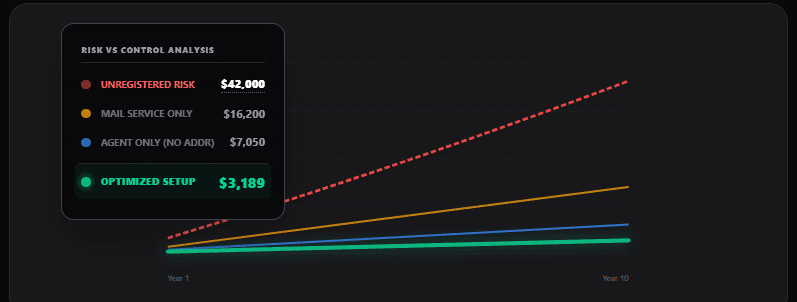
The Hidden Cost of “Zero Cost”
Many new U.S. commercial real estate (CRE) investors start with the assumption:
- “I’ll just use my home address for now.”
- “I’ll form my LLC later.”
At first glance, this may seem like a smart way to save money. But our simulator shows that an unregistered setup could expose you to over $19,750 in hidden costs over five years.
This article breaks down the legal, economic, and infrastructural logic behind that number—and why it’s not an exaggeration.
1. Exponential Risk: The Corporate Transparency Act (CTA)
The steep red dotted curve in our simulation represents the escalating risk caused by the new federal law that went into effect in January 2024: The Corporate Transparency Act (CTA).
⚖️ Legal Basis:
- Administered by FinCEN (Financial Crimes Enforcement Network)
- Requires all LLCs to submit BOI (Beneficial Ownership Information)
- Violations include civil penalties of up to $500/day (31 U.S.C. § 5336)
💡 Simulation Logic: Our "Unregistered" scenario calculates penalty exposure using statistical modeling of detection probability and filing delays. Even a few days of oversight can cost thousands in compounding fines.
2. Economic Perspective: The 120-Hour Friction Cost
The Time Efficiency Score of just 10/100 for self-managed investors is grounded in real-world economics—specifically, Nobel Laureate Oliver Williamson’s Transaction Cost Economics (TCE).
📊 Data Source: According to the U.S. Small Business Administration (SBA), small business owners spend an average of 120 hours/year on compliance tasks.
🧠 Opportunity Cost: Assuming your professional hourly value is $100, that equals $12,000/year in lost productivity. Outsourcing your compliance to Northwest Registered Agent transforms this "dead time" into revenue-generating hours—a net profit move, not a cost.
3. Physical Nexus & Bank Risk: The Address Factor
So why do "Mail Only" or "Agent Only" setups fail to match the Optimized Stack? Because of KYC protocols under the U.S. PATRIOT Act, which govern how banks verify your identity.
🏦 Risk: If your address is flagged as a CMRA (Commercial Mail Receiving Agency), your business bank account may be frozen or rejected. SBA loans and investor credibility also take a hit.
✅ Solution: Using a commercial-grade physical address from iPostal1 dramatically increases your Banking Readiness Score, eliminating delays and re-application costs.
4. Scenario Breakdown: The True Cost of Each Path
| Scenario | Core Cost Driver | Risk Score |
|---|---|---|
| Unregistered | BOI penalties + unlimited personal liability | Very High |
| Mail Only | Missed legal service of process (SOP) | High |
| Agent Only | Bank rejection → missed funding/loans | Medium |
| Optimized Stack | Fixed fees + 120 hours of saved time | Low (Safe) |
Final Verdict: Defense Is the New Growth
The annual cost of just $1,434 for an optimized setup is not an expense—It’s a shield backed by:
- iPostal1 for address anonymity and bank readiness
- Northwest Registered Agent for LLC compliance and data privacy
This simulation isn’t just a calculator. It’s your Deployment Blueprint, designed to protect your portfolio from the real enemy: Regulatory Uncertainty.
Architect’s Insight: Boosting Transparency and Trust
To increase credibility even further:
- System Efficiency Score: We break down the 80/100 score into five pillars: Compliance (20), Nexus (18), Privacy (17), Stability (15), and Time (10).
- Real-World Case Study: Investors have lost lease lawsuits simply because legal notices were sent to unused residential mailboxes. Don't let that be you.
Ready to apply this?
Don't just read. Execute using the tool built for this exact strategy.